
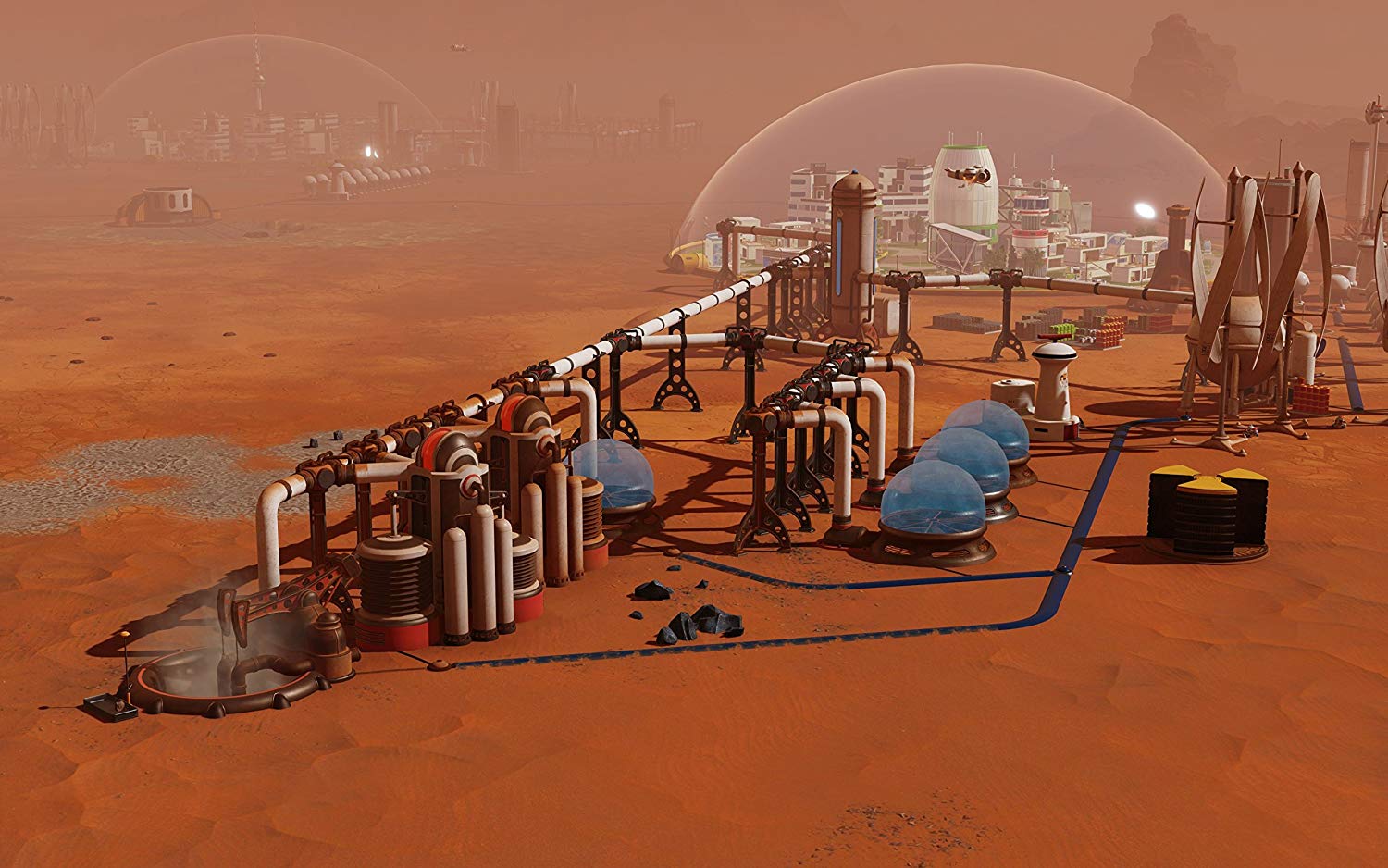
They always tell you to “get to Mars,” but they never tell you what to do once you get there. City building games have been around for as long as gaming itself. Considered one of the original genres in home gaming, city-building and survival simulations have taken us to every type of world there is. There are fantasy simulations, medieval castle-builders, modern cityscape constructors, and even the occasional off-world exploration sim.
There are as many types of city-builders as there are cities, even some that have taken us to Mars, but none of them compare to what we played for this Surviving Mars review.
COMPARISON TABLE
[amazon box= “B079M4FL1D,B06Y6DRQ6S,B07BHS4CNQ,B079788LPV” template=”table”]
What Is Surviving Mars?

It could be easy to mistake this simulation for all others as the aesthetic and basic mechanics are not necessarily innovative. Most survival and city building sims have the same basic premise: you are the all-powerful builder, the architect of this new civilization, and the people of this world are relying on you to design and implement a place they can live in peace and harmony. While that remains true throughout this Surviving Mars review, we quickly learned that, unlike most passive environments in other games, Mars is not keen on keeping us around for the long haul.
The basic start to the game does not differ from other survival sims, so it will feel familiar. As the head of a chosen agency, be it a private corporation or space-age nation, you must take the initial steps to colonize the red planet. The eventual goal will be a sustained and thriving population on Mars, but before you can colonize with living, breathing folks, you must wrangle up the necessary resources and get the base camp up and running. With the help of some friendly robots and automated rovers, you can brave the harsh environment and begin collecting the needed elements for survival.
At this point, most survival games become more of the same. Your job becomes more stockbroker and less environmental planner, with all of your attention turning to the continued growth against the rates of demand and population. Of all the games we’ve played for this Surviving Mars review, none of them cared less for your time and attention than this one, and that’s a good thing. While most simulation builders are content with letting you grow out that urban sprawl, Surviving Mars will not let you forget that things break, deteriorate, and eventually self-destruct.
The constant maintenance and attention needed for the colony to continue thriving is often maddening. The dust of Mars does not care that your colonists need oxygen to survive, and it will beat down on your respirator extractors until they are no more. There is a consistent need to maintain your machines while at the same time expanding and growing the population of colonists you are fighting to support.
Most city-building simulation games allow you to coast along once you’ve got that flow of taxes and commuter goods flowing in and out. A good strategist and patient player will have no problem expanding their empire and giving the citizenry everything they need once the town coffers are filled in abundance. Over the course of playing for this Surviving Mars review, we were consistently reminded that the old coast-on-the-coffers strategy was not going to work on the closest neighbor to Earth. Mars doesn’t want us there and works hard to show it with every turn of the day-night cycle.
Resource Management

As with almost every game in this genre, your ability to expand and thrive is based on the flow of resources in and out of your civilization. Your game begins with the selection of a parent organization that will give you certain advantages and resource buffs at the start of your colony. For example, if you choose to use a private corporation with the ultimate goal of harnessing the mineral resources of Mars, you will get a boost in that arm of production. In contrast to that, you can choose a space-forward country that will boost your initial money pool and make it easier to populate your empty glass domes.
The initial choice of skills and buffs is not a new mechanic for a survival building game, but it can have far-reaching implications as you move further into your colonial development. This becomes especially important when the end-game starts to kick in, and you are faced with a seemingly insurmountable challenge. The early game builds, and planning will all come to bear fruit once the end-game mystery closes in.
That brings us to our favorite part about this game, a feature unique to all the games in this Surviving Mars review: There is a mystery to solve.
What’s the Mystery?

One of the most common complaints about this type of simulation game is a lack of replay value. The goal of these games is fairly consistent, and it’s the same here, as you’re tasked with getting as many people there as possible. Though that mechanic is still the central theme of Surviving Mars, it’s not the end-game. The most amazing part of this game is the eventual and inevitable introduction of a narrative goal.
The inevitability of the collapse of your colony might just seem like a ticking clock mechanic, but from day one of your simulation the mystery has been selected, and fate has set it in motion. The clever addition to this mechanic is the random mystery event you will have to face. It might be a natural disaster in the form of unforgiving dust storms. It could be the total collapse of your oxygen production system. Sometimes, you might get some self-aware artificial intelligence that decides they no longer want to work for you. Because the regular resupply ships from Earth are crucial, something terrible back home could set the scene for your eventual demise.
Oh, and yes, to answer your first question, it could also be an alien invasion. The classic sci-fi tropes are on full display here and used in brilliant if not subtle ways. This design gives the player an ultimate end game goal with the mystery, something that not only makes it more exciting but gives it replay value often missing in these types of games.
How Does It Compare?
We’ve selected a few other games for this Surviving Mars review to see how they stack up against it.
- Aven Colony
- Frost Punk
- Planetbase
Surviving Mars
[amazon box=”B079M4FL1D”]
- PRICE
- GRAPHICS
- STORY
- CONTROLS
- GAMEPLAY
($15 – $30)
5.0 of 5 stars
The visuals are stunning and not as repetitive as some other options of this type. Of all the games played for this Surviving Mars review, this was the only one to embrace the photo-taking features present in some other classic sim games.
5.0 of 5 stars
This was five out of five, no question about it. The biggest fault in most city-building survival games is the lack of any kind of narrative. Introducing a mystery plot late in the game drives a new challenge and an exciting end-game.
3.0 of 5 stars
The controls were intuitive and easily used for in-game building. There was a tiny bit of lag in larger build areas, but that’s not uncommon for these types of games.
5.0 of 5 stars
Though the gameplay by itself sets this apart from all the others in this Surviving Mars review, introducing a mystery narrative gives this simulator a replay value missing from other competitors.
PROS
- Excellent replay value
- Challenging gameplay
CONS
- Lags on slow PCs
- Late-game difficulty curve
Aven Colony
[amazon box=”B06Y6DRQ6S”]
You are the leader of a new group of colonists, and it’s your job to help them survive the harsh elements of an alien world. This colorful and often animated building simulation and survival game will have you constantly watching your resources and keeping your colonists alive.
- PRICE
- GRAPHICS
- STORY
- CONTROLS
- GAMEPLAY
($10 – $20)
2.0 of 5 stars
Though it’s colorful and a treat for the eyes, the visuals leave a bit to the imagination, often looking more absurdist than real-world.
2.0 of 5 stars
As with most games seen for this Surviving Mars review, this one has the same generic plot offered for most survival building games. Build and harness resources, so your people don’t die. That’s it.
3.0 of 5 stars
The controls are simple enough, so there is really not much to complain about. The building mechanics are very close to Sim City and other games like it.
2.0 of 5 stars
The play-through is smooth and entertaining, but there’s little difference between this city-builder and every other one that came before it.
PROS
- Easy learning curve
- Adaptive controls
CONS
- Feels repetitive
- Cartoon-like visuals
Frost Punk
[amazon box=”B07BHS4CNQ”]
From the people that brought you This War of Mine comes Frost Punk, a survival simulation where you must control the last city on Earth and ensure the continuation of the human race. The world is frozen and cold, and only steam-powered retro-machines can save us.
- PRICE
- GRAPHICS
- STORY
- CONTROLS
- GAMEPLAY
($30 – $50)
4.0 of 5 stars
The use of a steam-punk world covered in ice is a nice break from the usual bright and colorful alien worlds of most simulation building games. There has been a lot of attention put towards the look of the game and that work pays off in the end.
4.0 of 5 stars
Out of every title in this Surviving Mars review, Frost Punk comes the closest to matching the exciting mystery that comes late in the game. Though the main focus is on building and survival of your society, in order to figure out what happened, your freezing world will require you venturing out and exploring the harsh terrain.
3.0 of 5 stars
The building and maintenance controls are easy to learn and can be mastered in a few hours of game play. The HUD and associated controls are user-friendly and work well throughout the game.
4.0 of 5 stars
This title was a lot of fun and is definitely recommended for someone that likes the bleak world of steam-punk combined with the intense resource management of games like Factorio or Sim City.
PROS
- Cool visuals
- Narrative mysteries
CONS
- Early game is slow
- Can lag on some computers
Planetbase
[amazon box=”B079788LPV”]
At first glance, Planetbase might look a little too vanilla compared to the other titles in this Surviving Mars review, but don’t let that fool you. A more traditional building-survival game, Planetbase will require all of your management skills to build a thriving colony on a foreign world.
- PRICE
- GRAPHICS
- STORY
- CONTROLS
- GAMEPLAY
($20 – $30)
2.0 of 5 stars
There’s nothing spectacular about the visuals in this game, but they do what they can to get the point across. It’s not harsh on the eyes, per se, but the minutia of the operations in your colony can look messy if not running on a good graphics card.
2.0 of 5 stars
The same generic story as always. Surprise, you’re the manager/leader of the group. You must choose the world to inhabit, harness the natural resources, and protect your people from death and invasion.
4.0 of 5 stars
The controls are adaptive and easy to learn in the beginning stages of the game. This makes for a soft learning curve that never really steps up later in the game.
3.0 of 5 stars
The biggest thing this game has going for it is the replay value. You must choose a world to inhabit at the beginning, with each one giving different resources and challenges as the game progresses. This makes each colony a little different from the other, giving more replay value than most games of this type.
PROS
- Replay value
- Well-balanced challenges
CONS
- Repetitive missions
- Vanilla graphics
Surviving Mars Review – In Conclusion (5/5 Stars)
We really enjoyed our time with Surviving Mars and would highly recommend it to any fan of this genre of games. The replay value is amazing and offers exciting mysteries each time through.
Because of this and so much more, we give Surviving Mars five out of five stars.